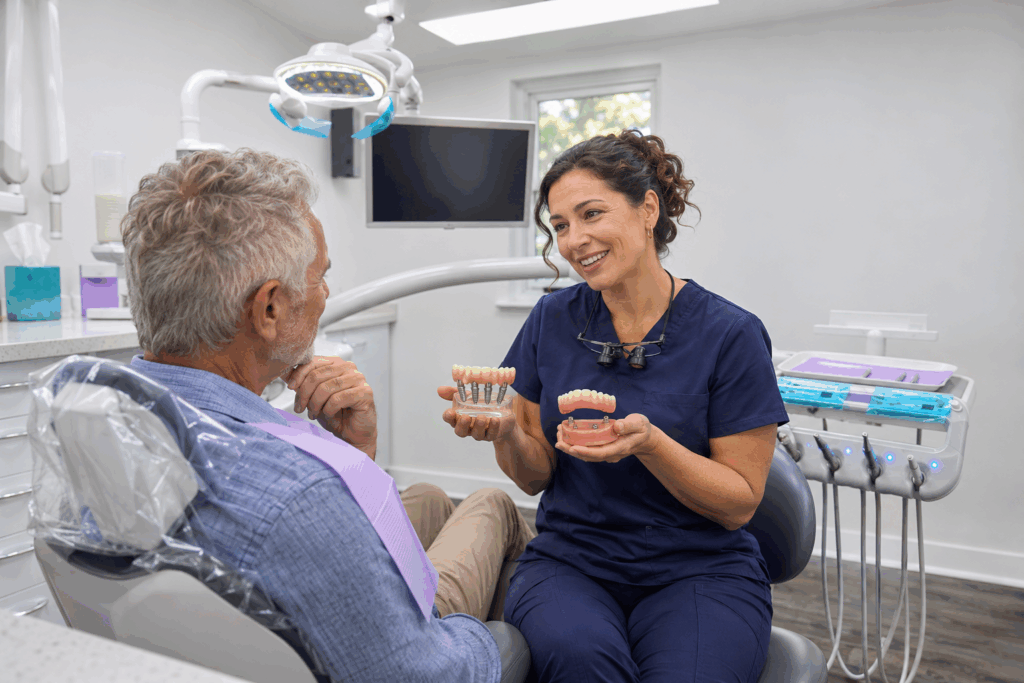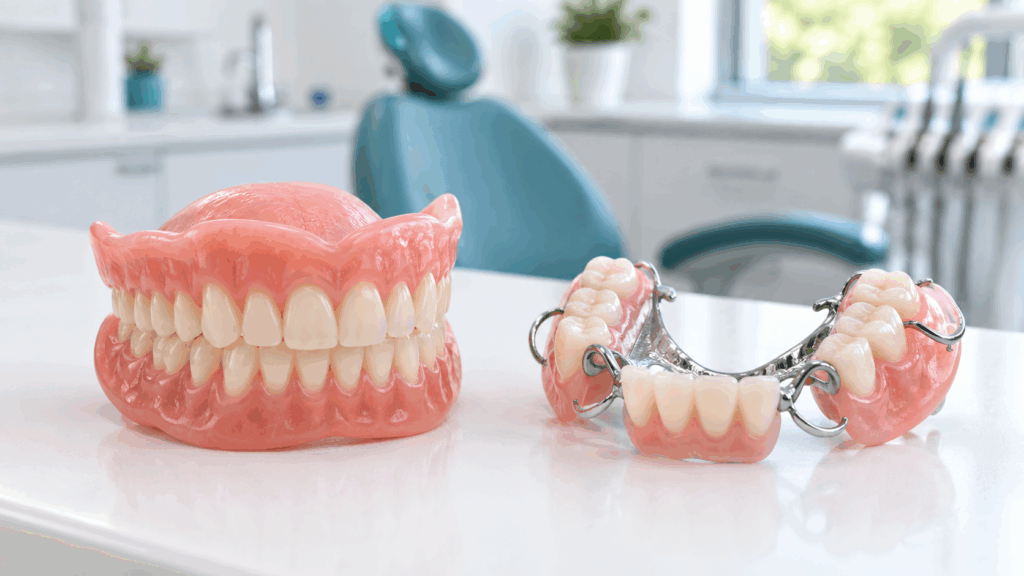
All-on-4 vs implant dentures is a comparison between two ways to replace a complete arch of missing or failing teeth with implant support. All-on-4 commonly refers to a fixed full-arch restoration supported by strategically placed implants. Implant dentures often refer to a removable overdenture that connects to implants for added retention. Both can improve stability compared with a conventional denture, but they differ in removability, cleaning, treatment planning, and cost.
At Smile Maker PA in Southampton, PA, the right full-arch plan depends on bone anatomy, gum health, medical history, remaining teeth, bite forces, maintenance needs, and personal priorities. An examination and three-dimensional imaging may be needed before a recommendation can be made.
All-on-4 vs implant dentures: quick comparison
| Factor | All-on-4 fixed full-arch teeth | Removable implant denture |
|---|---|---|
| Daily removal | Generally stays attached and is removed only by a dental professional | Patient removes it for routine cleaning |
| Stability | Designed for strong fixed support | More stable than a conventional denture but still removable |
| Cleaning | Requires special cleaning under the restoration | Cleaned outside the mouth as directed |
| Implant number | Often planned around four or more implants, depending on the case | Implant number varies with anatomy and design |
| Tissue support | Primarily implant-supported | May use both implants and gum tissue for support |
| Repair pathway | Professional service is required | The denture or attachments may be serviced separately |
| Cost factors | Often higher because of surgery, components, and a fixed prosthesis | May have a lower initial fee, depending on the design |
The phrase All-on-4 describes a treatment concept, not a promise that exactly four implants will work for every patient. The final design must be based on clinical findings.
What are All-on-4 dental implants?
All-on-4 dental implants support a complete fixed arch of replacement teeth. The implants act as anchors in the jaw, and the full-arch restoration connects to them. In selected cases, a temporary fixed restoration may be placed around the time of surgery, but healing, bite forces, and implant stability determine whether immediate loading is appropriate.
Patients often consider this approach because the teeth remain in place and can feel more like a fixed restoration. It still requires daily cleaning around and under the prosthesis, professional maintenance, and periodic evaluation of the implants and components.
What is a removable implant denture?
A removable implant denture, sometimes called a snap-on denture or implant overdenture, connects to implants through attachments. The implants improve retention, while the patient removes the denture for cleaning and usually while sleeping if instructed.
This option may reduce movement during speaking and eating compared with a conventional denture. Attachments can wear over time and may need replacement. The denture base, bite, fit, gums, and implants also need routine evaluation.
Stability, chewing, and speech
Both options can offer better retention than a conventional removable denture. A fixed restoration usually has less movement because it is secured to the implants. A removable implant denture can still move slightly, especially when the design also rests on gum tissue.
Chewing ability depends on more than the attachment type. Implant position, opposing teeth, bite balance, muscle control, prosthesis design, and healing all matter. Speech and comfort also require an adjustment period with either option.
In an All-on-4 vs implant dentures decision, the most stable design is not automatically the best design for every mouth. Cleaning ability and long-term service access are equally important.
Candidacy and treatment planning
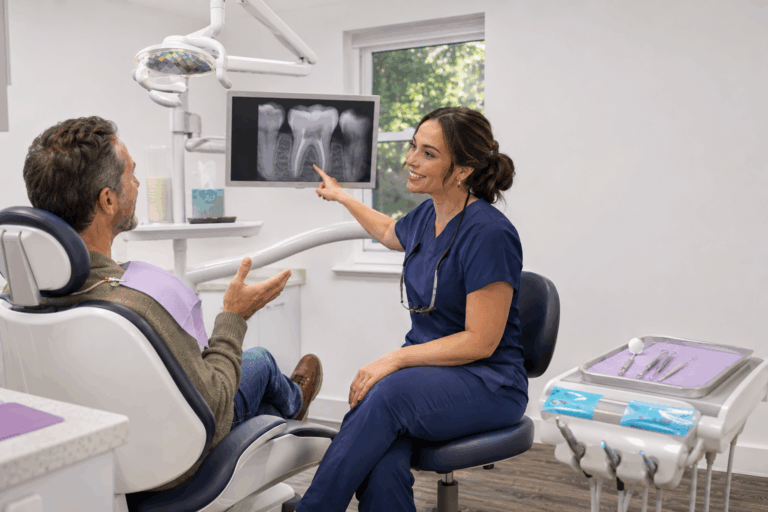
An implant evaluation may include a medical and dental history, examination, digital imaging, bite analysis, and review of existing teeth. Important factors include:
- Bone volume and quality in the planned implant areas
- Active gum disease or infection
- Smoking or vaping
- Diabetes control and other health conditions
- Medications that affect bone or healing
- Tooth grinding and bite forces
- Ability to clean and attend maintenance visits
- Expectations for appearance, function, and removability
The American College of Prosthodontists explains that implants may support one tooth, several teeth, or all teeth and that treatment should be determined by individual needs. Some patients need extractions, bone grafting, periodontal care, or medical coordination before implant placement.
Treatment steps and timing
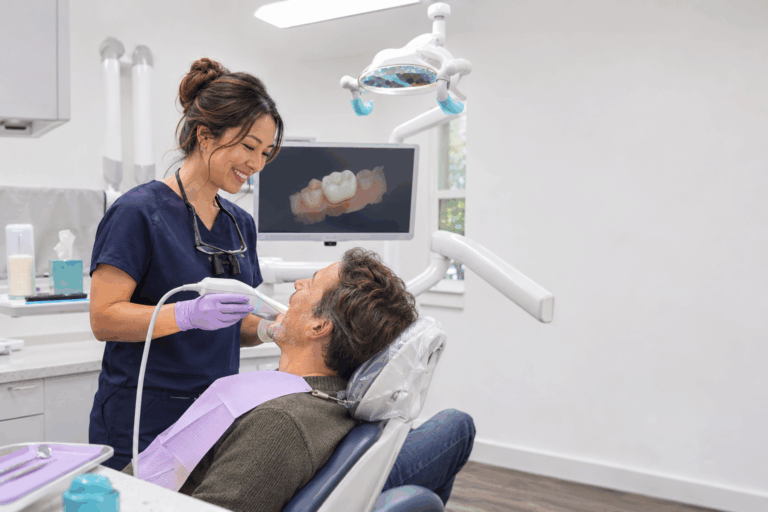
A full-arch plan generally begins with records and digital planning. If teeth must be removed, extractions may occur before or during implant placement. A temporary restoration may be used while the implants integrate with the bone. The final restoration is made after the surgical and restorative conditions are ready.
All-on-4 vs implant dentures timelines vary because healing is biological. Additional procedures, implant stability, medical history, and the final prosthesis design can change the sequence. A consultation should distinguish a provisional restoration from the final teeth.
Daily cleaning and professional maintenance
A fixed full-arch restoration is brushed and cleaned underneath with tools recommended by the dental team, such as threaders, interdental brushes, or a water flosser. A removable implant denture is taken out so both the prosthesis and the implant attachments can be cleaned.
Neither option is maintenance-free. Call the dental office if you notice bleeding, swelling, bad taste, pain, movement, a change in bite, a damaged tooth, or difficulty seating a removable denture. Regular implant maintenance helps the team evaluate gum health, bone levels, attachment wear, and prosthetic components.
All-on-4 vs implant dentures cost factors
All-on-4 vs implant dentures cost cannot be compared accurately without a personalized plan. Fees may be affected by:
- Number and type of implants
- Extractions or bone grafting
- Sedation choices
- Temporary and final prostheses
- Restorative material
- Laboratory and digital planning
- Repairs and maintenance included in the plan
- Dental insurance benefits and financing
A fixed full-arch restoration is often more expensive initially because of its components and fabrication. Ask for a written estimate that separates surgical, temporary, final, and maintenance costs. Smile Maker PA provides information about dental financing and insurance.
How to choose between the options
Ask whether the recommended teeth are fixed or removable, how many implants are planned, what happens during healing, how the restoration is cleaned, and what future repairs may cost. Also ask whether a conventional denture or another dental implant design should be considered.
The best All-on-4 vs implant dentures choice is the one that fits your anatomy, health, hygiene ability, function, and budget rather than the option with the most appealing name.
Schedule a full-arch implant consultation
To compare fixed and removable full-arch options, call Smile Maker PA at (215) 969-2015 or request a Dental Appointment. The office is located at 1775 Street Rd., Southampton, PA 18966.
FAQ about All-on-4 vs implant dentures
Is All-on-4 the same as an implant denture?
Not exactly. All-on-4 usually describes a fixed full-arch restoration, while implant denture often describes a removable overdenture. Terminology varies, so confirm whether the proposed teeth stay fixed or are removed by the patient.
Which option feels more like natural teeth?
A fixed restoration generally has less movement and may feel more like fixed teeth. Sensation and chewing still differ from natural teeth because the restoration and implants do not have the same anatomy as natural tooth roots.
Can implant dentures become fixed later?
Sometimes, but conversion is not guaranteed. Implant number, position, angle, bone, bite, and restorative space must support the new design. A new prosthesis and additional implants may be required.
How long does treatment take?
Timing ranges from several months to longer depending on extractions, grafting, healing, implant stability, and the final restoration. A temporary restoration does not mean treatment is complete.
Are four implants always enough?
No. Four implants may be appropriate in selected cases, but anatomy, forces, implant distribution, and the planned prosthesis determine the number needed.
Which option is easier to clean?
A removable implant denture is often easier to access because it comes out. A fixed restoration requires careful cleaning underneath. The better option depends partly on dexterity and willingness to follow the maintenance routine.